


How the University of Georgia Embraces ‘Stop the Bleed’
24th Aug 2017
UGA and its local public safety agencies are taking part in this national campaign, which encourages greater awareness of straightforward first aid strategies.
In 2013, the White House introduced the “Stop the Bleed” campaign to encourage bystanders to assist with lifesaving bleeding control procedures in their communities. Specifically, the national campaign encourages an increased awareness of straightforward and easily-taught first aid strategies, already in use by the military and many first responder agencies. It also calls for having bleeding control equipment readily accessible for the public.
The University of Georgia (UGA) in Athens, Ga., recognized the importance of enhanced first responder training in conjunction with bystander intervention, and has embraced the “Stop the Bleed” campaign on many levels.
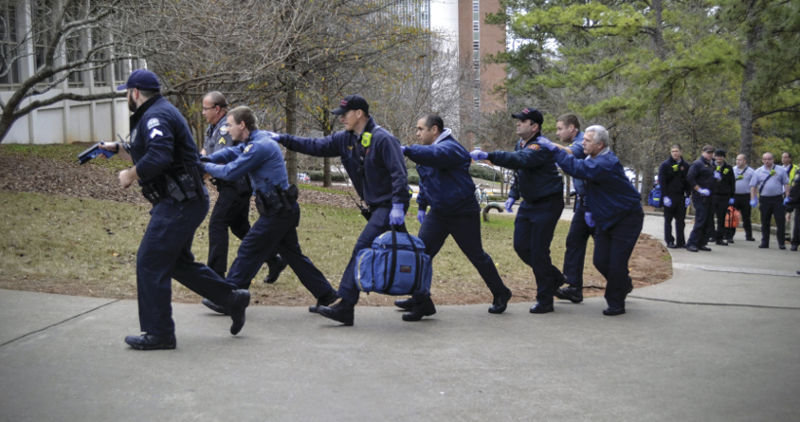
On a foundational level, UGA and local public safety agencies adopted the Hartford Consensus policies in 2014 and began engaging the local fire department and emergency medical service (EMS) personnel to train to respond more actively to mass casualty incidents like an active shooter attack or an explosion.
In the Hartford Consensus document, a group of healthcare and government leaders responded to the 2012 shooting at Sandy Hook Elementary School by developing suggested practices and policies that provide for improved survivability rates from mass casualty incidents.
UGA Police Medical Tahoe Contents:
- 5 Individual First AidKits (chest seals, CATtourniquet, hemostaticgauze, trauma shears,gloves, etc.)
- 5 Portable stretchers
- 1 Portable AED in ahardened case
Stop the Bleed Kit Contents in Each AED Cabinet
- 1 CAT tourniquet
- 2 Packs ofcompressed gauze
- 1 Emergencytrauma dressing
- 2 Pairs of gloves
- 1 Trauma shears
- 1 Permanent marker
As a result of the Hartford Consensus, policy changes began to occur in Athens and on the UGA campus where fire and EMS units actively coordinated with law enforcement in mass casualty training exercises to set up either a casualty collection point or to enter “warm zone” areas with law enforcement escorts to assist with patient care – despite the scene not being deemed 100 percent safe. Traditionally, fire and EMS units would have staged a significant distance away from the incident until law enforcement cleared the entire building or scene while many people with potentially survivable injuries awaited medical assistance for long periods of time.
These changes came as the UGA Police Department had already started to rethink its medical response training and protocols, and had incorporated a variety of new tools to increase the emergency medical capacity of police personnel.
Officers, Bystanders Receive Training and Equipment
In the early phases of the changes, each police vehicle was equipped with a Stop The Bleed Kit, and officers were taught to use tourniquets, hemostatic bandages and occlusive chest seals in the event of life-threatening trauma; later, each officer was also issued a tourniquet for their duty belt.
More recently, four patrol vehicles have been specially designated and marked to carry five additional Stop The Bleed Kits to supplement the police response to a mass casualty event, and each officer has also been trained in the use of Naloxone to counteract the effects of an opioid overdose.
In a joint initiative with the UGA Office of Emergency Preparedness (OEP), each police vehicle now also contains an automatic external defibrillator (AED) and several portable stretchers.
In order to encourage more bystander intervention from the UGA campus community, the OEP, which manages the campus automatic external defibrillator program that consists of more than 225 AEDs on campus, added bleeding control kits to each AED cabinet over the summer of 2016. This effort was prompted by a similar initiative by the Charlotte Douglas International Airport in North Carolina, where bleeding control kits are located in AED cabinets in the terminal. UGA emergency management personnel concluded that bleeding control kits would be a natural fit for UGA’s AED program since much work has been completed to centrally manage the campus AED program.
Campus AED cabinets that contain a bleeding control kit are marked on the outside of the cabinet with a highly visible sticker that indicates a “Stop the Bleed” kit is inside. Each bleeding control kit contains non-expiring items, including a CAT tourniquet, an emergency trauma dressing, compressed gauze, two pairs of gloves, trauma shears, a marker and an instruction card.
The bleeding control kits are intended for severe bleeding where traditional methods such as compression may have little impact. Although most bleeding control kits are intended for worst-case scenarios like active shooter events and potential explosions, OEP believes that the kits will likely be utilized for more common emergencies like glass cuts in campus lab environments, injuries to facilities and grounds personnel, car accidents or sports injuries.